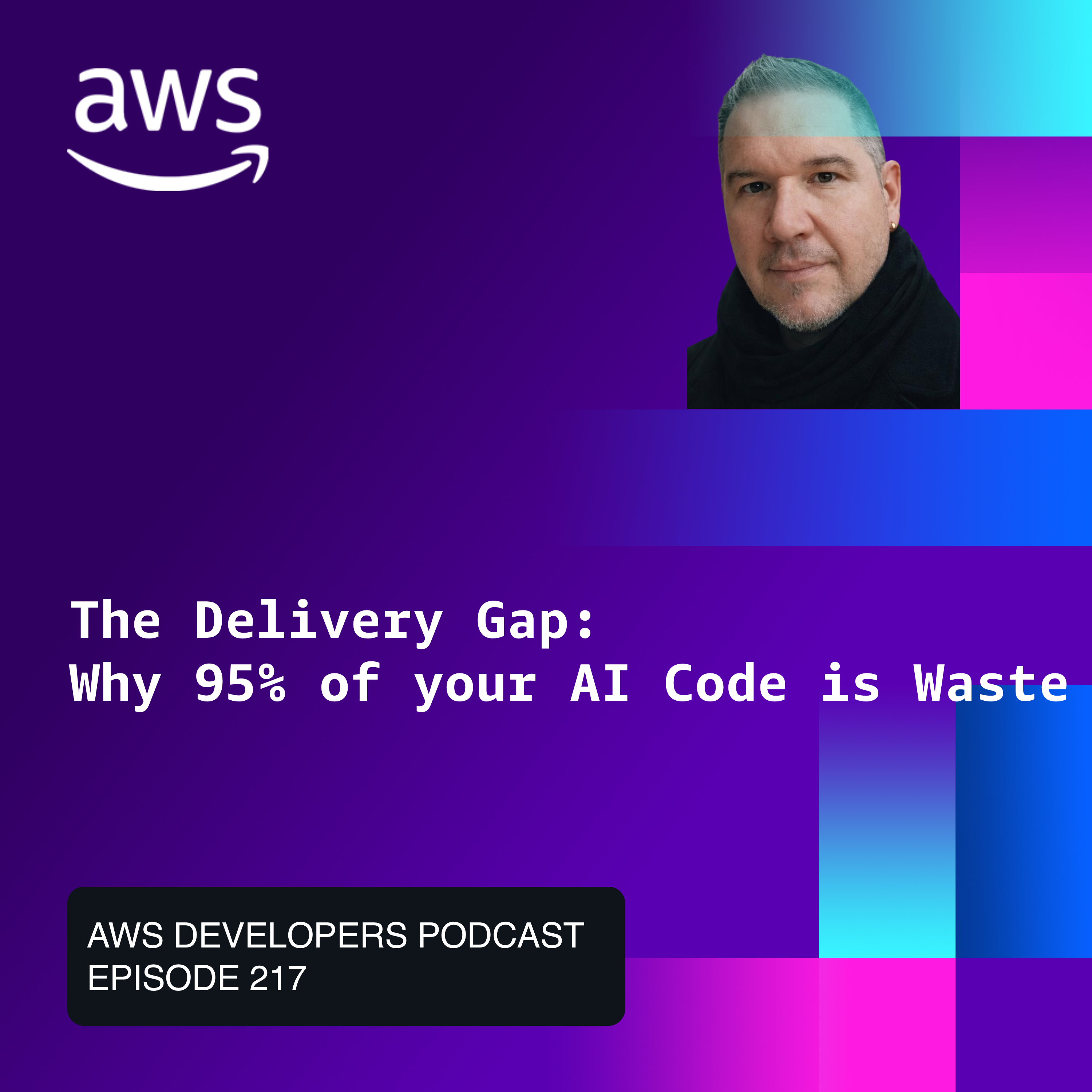
Episode 217
The Delivery Gap: Why 96% of Your AI Code Is Waste
Jul 15, 26 • 01:07:45
With Brenn, Senior Manager at Delivery Hero & Author of The Delivery Gap
The AWS Developers Podcast
Episode 217
Jul 15, 26 • 01:07:45
With Brenn, Senior Manager at Delivery Hero & Author of The Delivery Gap
Brenn reached out via LinkedIn to share his experience with AI-driven software development and his new book, The Delivery Gap. Romain read a copy during a business trip and found it deeply aligned with how he guides customers through their AI transformation — and discovered a few new angles worth exploring, including a convergence on cost tracking that maps directly to Amazon's internal cost to serve software metric. In this episode, Brenn — Senior Manager at Delivery Hero (one of the world's largest food delivery companies, operating in 65 countries) — breaks down why most companies fail to see returns from AI coding tools despite individual developers feeling more productive. The core insight: generating code 10x faster means nothing if your verification infrastructure can't keep up. You're just driving 10x faster into a wall. Key takeaways: • The 96% waste problem — If you generate 100 PRs and only 4 make it to production and stay there, the other 96 are waste. Measuring PRs created is meaningless; measure what ships and survives. • The verification triangle — Your delivery speed is governed by verification infrastructure, not generation speed. Banks can't release faster than they can audit. Find your constraint — that's where investment should go, not more coding tools. • Cost per accepted change — Total token costs + human time for all PRs, divided by changes that reach production and stay there. This single metric reveals where waste accumulates and aligns with Amazon's cost to serve software model. • Specs as alignment documents, not source code — Specs align humans and AI on intent and why, not for deterministic code generation. The same spec produces different software each time. Focus on why; let the AI document the what. • Keep agents small and focused — Every MCP server re-injected into context is a cost multiplier per turn. The smallest, tightest, most precisely aimed agent outperforms a Swiss Army knife agent on both cost and accuracy. Apply cost per accepted action to measure agentic ROI.
Links
Here are the links to the tools, technologies, or articles we mentioned in this episode.
The Delivery Gap — Brenn's Book
Business Value of Developer Experience Improvements: Amazon's 15.9% Breakthrough
Delivery Hero — Global Food Delivery Platform
AWS DevOps Agent
Kiro — AI-Powered Development Environment
The Phoenix Project — Gene Kim, Kevin Behr, George Spafford (Book Recommendation)
The DevOps Handbook — Gene Kim, Jez Humble, Patrick Debois, John Willis (Book Recommendation)
Warp — AI-Powered Terminal (Brenn's Dev Tool Pick)
Brenn on LinkedIn
Episode 214 — AWS DevOps Agent: Can Your Pipeline Keep Up with AI?